


As a supplier of Steel Storage Pallets, I've had the privilege of working closely with both European and American markets. Over the years, I've noticed distinct differences in the design of steel storage pallets used in these two regions. These differences are influenced by a variety of factors, including industry standards, transportation requirements, and end - user preferences. In this blog, I'll delve into these differences to help you better understand the unique features of European and American steel storage pallets.
Structural Design
One of the most noticeable differences between European and American steel storage pallets lies in their structural design. European pallets often feature a more compact and standardized design. The European market has well - established pallet sizes, such as the EUR1 (800 x 1200 mm) and EUR2 (1000 x 1200 mm). These standard sizes are widely used across Europe, which allows for better compatibility with European logistics systems, including forklifts, racks, and shipping containers.
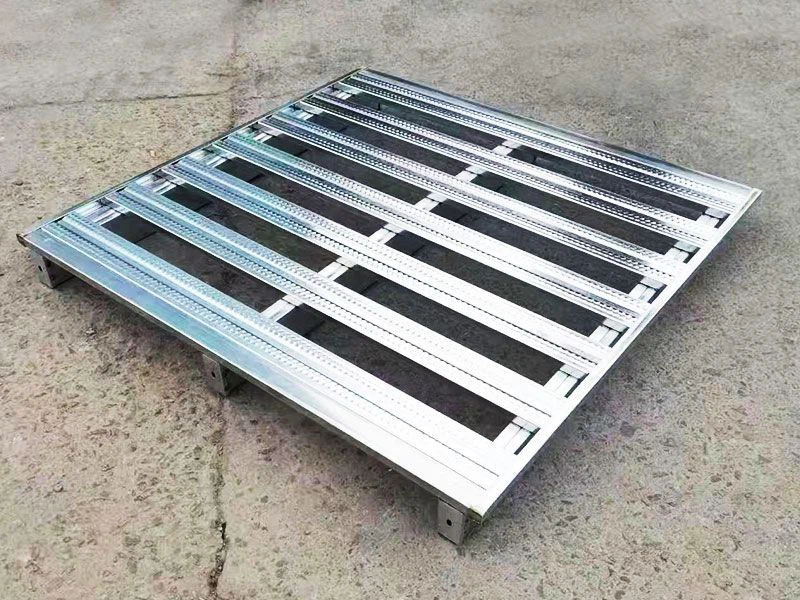
European steel pallets are typically designed with a focus on stability and load - distribution. They often have a grid - like structure on the top deck, which provides a flat and even surface for storing goods. This grid design also helps to reduce the weight of the pallet while maintaining its strength. For example, some European steel pallets use a series of parallel bars or tubes on the top deck, which are welded or riveted to the frame. This design not only distributes the load evenly but also allows for easy cleaning and drainage.
On the other hand, American steel storage pallets tend to be larger and more diverse in size. The most common pallet size in the United States is the 48 x 40 inches (1219 x 1016 mm) pallet. However, there are also many other non - standard sizes used in the American market, depending on the specific industry and application. American pallets are often designed to handle heavier loads and are more robust in construction.
American pallets may have a more solid top deck compared to European pallets. Instead of a grid - like structure, they may use a solid sheet of steel on the top, which provides a more stable surface for heavy or irregularly shaped goods. This solid top deck also helps to prevent small items from falling through the pallet. Additionally, American steel pallets often have a reinforced frame and corner posts to withstand the rigors of heavy - duty use.
Material and Coating
The choice of materials and coatings for steel storage pallets also varies between Europe and America. In Europe, environmental regulations and sustainability concerns play a significant role in material selection. European steel pallets are often made from high - quality, recycled steel. Recycling steel not only reduces the environmental impact but also helps to keep the cost of production down.
In terms of coatings, European pallets commonly use galvanized coatings. Galvanization is a process of applying a protective zinc coating to the steel to prevent rust and corrosion. Double - sided galvanized pallets are particularly popular in Europe. Double - Sided Galvanized Pallets offer excellent corrosion resistance, making them suitable for use in a variety of environments, including outdoor storage and humid conditions.
In the United States, the focus is more on durability and performance. American steel pallets are often made from thicker and stronger steel to handle heavier loads. While galvanized coatings are also used, American pallets may also use other types of coatings, such as powder coating. Powder coating provides a more durable and aesthetically pleasing finish compared to galvanized coatings. It can also be customized in different colors, which is useful for color - coding pallets in a warehouse or distribution center.
Fork Entry and Handling
Fork entry is an important aspect of pallet design, as it affects how easily pallets can be handled by forklifts and other material - handling equipment. European steel storage pallets typically have a four - way fork entry design. This means that forklift forks can enter the pallet from all four sides, which provides greater flexibility in handling and storage. Four - way fork entry is essential for European logistics systems, where pallets are often moved and stored in tight spaces.
American pallets, on the other hand, commonly have a two - way or four - way fork entry design, depending on the application. Two - way fork entry pallets are typically used for applications where pallets are stored in racks with narrow aisles. In these cases, the forklift only needs to enter the pallet from one or two sides. Four - way fork entry pallets are used in more general applications where greater handling flexibility is required.

Industry Standards and Regulations
Both Europe and America have their own set of industry standards and regulations for steel storage pallets. In Europe, the European Pallet Association (EPAL) sets the standards for pallet design, manufacturing, and quality control. EPAL - certified pallets are widely recognized and used across Europe. These pallets must meet strict requirements in terms of size, material, and construction to ensure compatibility and safety in the European logistics network.
In the United States, the National Wooden Pallet and Container Association (NWPCA) and the Material Handling Industry (MHI) play important roles in setting standards for pallets. However, the American market is more decentralized, and there is a greater variety of pallet designs and sizes that meet different industry - specific requirements. American pallets may also need to comply with regulations related to food safety, transportation, and environmental protection.
End - User Preferences
End - user preferences also contribute to the differences in design between European and American steel storage pallets. In Europe, where space is often limited in warehouses and distribution centers, pallets that are compact, stackable, and easy to handle are highly valued. European customers also tend to place a greater emphasis on environmental sustainability and cost - effectiveness.
In the United States, end - users often require pallets that can handle heavy loads and are suitable for long - distance transportation. American customers may also be more willing to invest in pallets with advanced features, such as RFID tags or other tracking technologies, to improve supply chain visibility and efficiency.
Conclusion
In conclusion, there are significant differences in the design of European and American steel storage pallets. These differences are influenced by a variety of factors, including structural design, material and coating choices, fork entry and handling, industry standards, and end - user preferences. As a Steel Storage Pallet supplier, it's important to understand these differences to meet the specific needs of customers in both markets.
Whether you're a European or American customer, we offer a wide range of steel storage pallets to suit your requirements. Our Chuan - Type Metal Pallets are just one example of our high - quality products that combine the best features of both European and American designs. If you're interested in learning more about our steel storage pallets or would like to discuss your specific needs, please feel free to contact us for a detailed consultation and procurement discussion.
References
- European Pallet Association (EPAL) official documentation
- National Wooden Pallet and Container Association (NWPCA) reports
- Material Handling Industry (MHI) research papers
- Industry journals and publications on logistics and material handling


